
Ka-4519: Acinos 🖋⸙
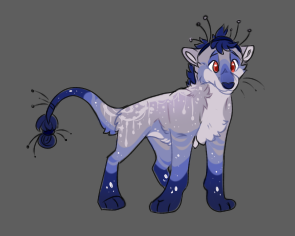
His preparation always began with hydration. Acinos would stand beneath a forest drip-line for hours, allowing his porous skin to absorb every drop of mineral-rich rainwater until his slender limbs felt heavy and supple. Next came the gear. He didn't carry steel or heavy packs; instead, he wore a vest woven from dried willow bark, fitted with dozens of small, glass vials.
Into these vials, he harvested various spores. Some were thick and yellow, meant to be puffed into the air to detect invisible drafts; others were caustic, a defense mechanism against the apex predators of the deep. Finally, he checked his glow. By focusing his intent, he could stimulate the chemical reactions within his own "cap"—a bioluminescent mantle that draped over his head like a living hood. As he stood at the cave's mouth, a soft, neon-emerald light pulsed rhythmically, pushing back the oppressive shadows of the limestone entrance.
What was Acinos after? To the uninitiated, it looked like he was merely poking at rocks. In reality, he was a seeker of the Primal Mycelium.
Legends of his kind spoke of a fungal network that predated the trees, a singular organism that lived in the absolute zero-light zones where the earth’s internal heat met the cold breath of the abyss. This ancient strain was said to hold the collective memory of the world’s first forests. Acinos sought "veins" of this network—glowing, calcified threads that grew in the most inaccessible chimneys of the cave systems. He wasn't there to harvest it for profit, but to "listen" to it. By pressing his palm against the ancient growth, he could feel the slow, tectonic heartbeat of the planet, gaining insights into upcoming shifts in the ecosystem above.
To an outsider, the dark, cramped, and damp environment of a cave might seem like a nightmare. For Acinos, it was the closest thing to a sanctuary.
He enjoyed it with a quiet, vibrating intensity. He loved the way the silence in a cave wasn't actually silent—it was a symphony of dripping water, the groan of shifting plates, and the rhythmic scuttle of multi-legged insects. He felt a profound sense of kinship with the stillness. In the forest above, there was too much competition: the sun was too loud, the wind too chaotic. But in the belly of the earth, Acinos was the brightest thing in the room.
There was a specific joy he found in "scaling" vertical shafts. Using the sticky, adhesive pads on his fingertips—a trait evolved from the Mycena’s ability to cling to rotting logs—he would traverse the ceilings like a luminous spider. Looking down at a thousand-foot drop into a black pool, he wouldn't feel fear. He would feel a sense of weightless belonging.
As he ventured deeper, his glow would reflect off the wet stalactites, turning the cavern into a cathedral of glass. In those moments, far from the reach of the sun and the demands of the surface world, Acinos wasn't just a traveler. He was a part of the geology itself, a living spark in the eternal dark, perfectly content to be lost in the magnificent, crushing weight of the world.